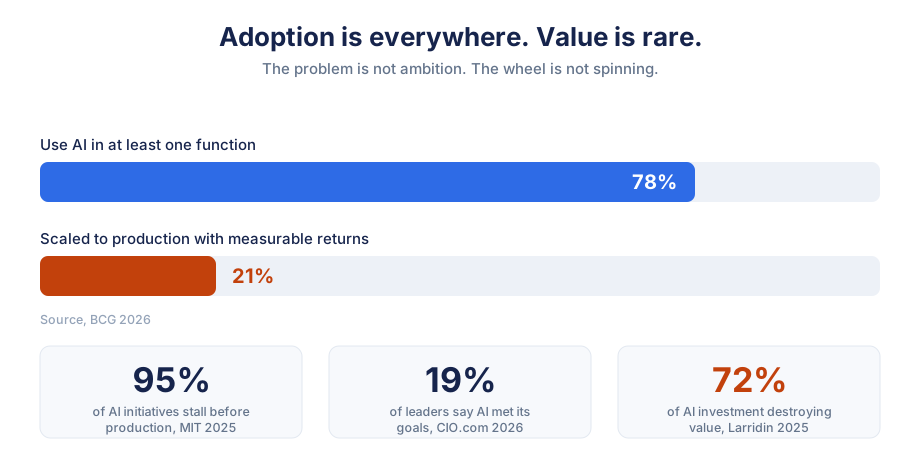
Adoption is everywhere. Value is rare.
What you'll get from this guide
- Why AI is running all over your org and still not paying off
- The flywheel that moves AI from pilot to production
- The five levels of readiness, and where you actually sit
- A six-dimension self-assessment that names what is blocking you
- A 90-day first move based on your level, not a generic checklist
Your people are already using AI. The question is whether you can see it, whether you can trust it, and whether any of it is connected to real work yet. That is what enterprise AI readiness measures. Not whether you have the tools. You have the tools. Readiness is whether you can govern what is already loose in the building and turn it into something that scales.
Most leaders cannot, and the numbers say so. Around 78 percent of organizations now use AI in at least one business function, yet only about 21 percent of AI initiatives have scaled to production with measurable returns (BCG, 2026). Less than a fifth of IT leaders, 19 percent, say their AI work has met or exceeded its business goals (CIO.com State of the CIO 2026, surveying 662 IT leaders).
So the gap is not ambition. Everyone has ambition. This guide gives you the shape of the fix. A flywheel that explains why adoption stalls, a five-level ladder so you can place yourself honestly, and a six-part assessment that tells you exactly which part is jammed. Pair it with the AI enablement guide once you know where you stand.
What enterprise AI readiness actually means in 2026
Enterprise AI readiness is your capacity to run two opposite forces at the same time. Guardrails from the top and creativity from the bottom. It is not a tool count or a license tally. It is whether sanctioned use, real governance, and a data foundation can hold together while people across the business find and scale use cases that pay off.
Here is the trap. Leaders measure readiness by what they bought. The tools are the easy part. The hard part is that AI arrived in your org through the side door, employee by employee, before any policy existed.
Shadow AI
The AI tools, models and apps employees adopt without approval, visibility or security oversight from IT or leadership. It is where most enterprise AI actually lives before anyone governs it. Some 83 percent of finance and IT leaders report it growing faster than IT can track it (Larridin, 2025).
The two ways to fail
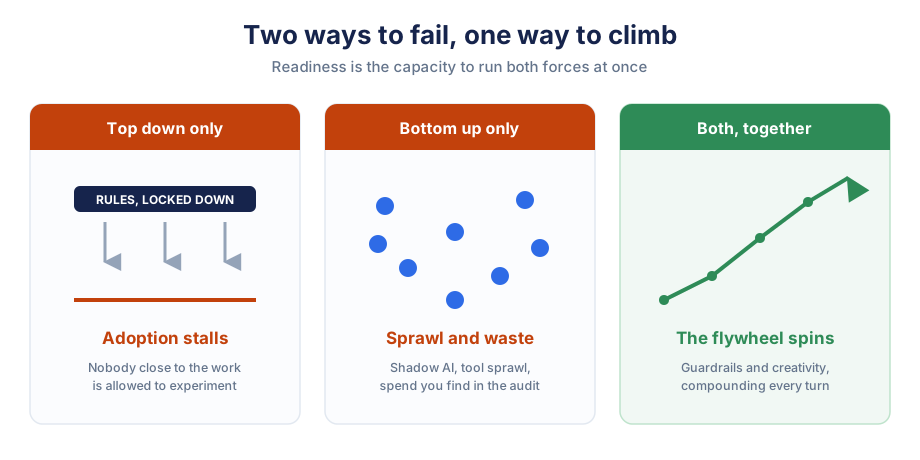
You have probably seen both. The first is the top-down stall. Leadership issues a mandate, locks everything down, waits for a strategy deck, and adoption flatlines because nobody closest to the work is allowed to experiment.
The second is the bottom-up sprawl. Everybody adopts something, nothing connects, spend leaks everywhere, and you find out which tools you own only during the audit. Around 72 percent of AI investment is currently destroying value rather than creating it, driven by exactly this sprawl (Larridin, 2025).
Ready means neither. Ready means both forces running together, on purpose.
The governed adoption flywheel
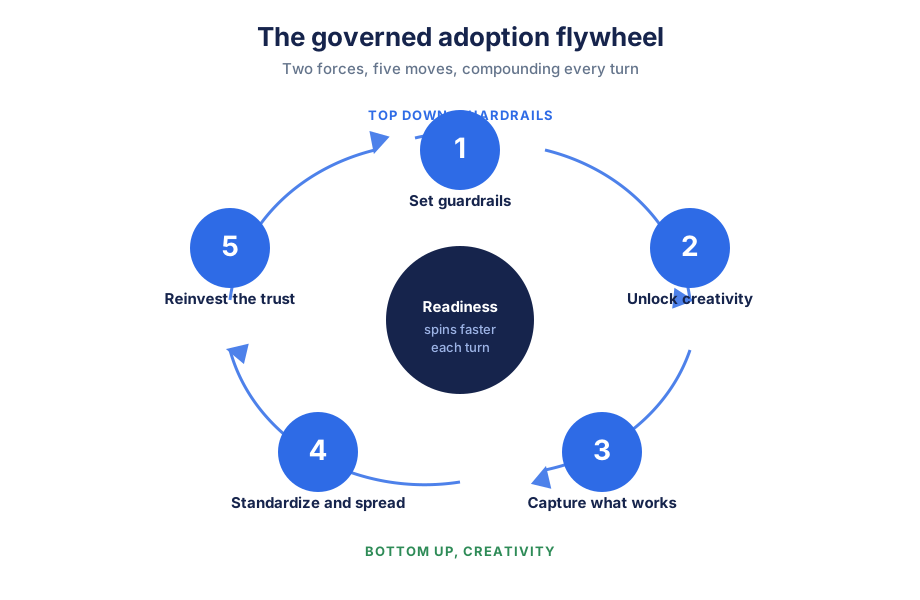
The engine of AI readiness is a flywheel, not a roadmap. You set guardrails, unlock creativity inside them, capture what works, spread it across functions, and reinvest the trust you earned into wider permission. Each turn makes the next turn easier. That compounding is what readiness feels like from the inside.
This is not a theory borrowed from a vendor deck. It is how Oz Rashid, MSH's founder and CEO, built AI adoption inside MSH itself. Rather than handing down a blanket "we need AI, go make AI happen" order, the kind boards are pushing on leadership right now, he set a governance structure and global rules first, then let individuals and function leads pull real use cases out of the work. The ones that worked and could be deployed consistently got moved across functions. Top down for the rules. Bottom up for the wins.
His read on why that balance matters is worth sitting with. People are going to use AI one way or another, he points out, because it works like a steroid for getting things done, so you want visibility and transparency without smothering the creativity. Lock it down and you lose the wins. Leave it open and you lose control. The flywheel is how you hold both.
The five moves
- Set guardrails. Global rules, decision rights, a data foundation that can actually feed AI. Top down.
- Unlock creativity. Sanctioned tools and clear permission so people closest to the work can experiment safely. Bottom up.
- Capture what works. Surface the use cases that deliver, measure them, separate the real wins from the demos.
- Standardize and spread. Move proven use cases across functions so one team's win becomes everyone's baseline.
- Reinvest the trust. Every governed win earns wider permission and tighter, smarter guardrails, so the wheel spins faster.
Why the rudder comes before the motor
If you add a large motor to a boat with a strong rudder, it will achieve superior performance. If you add a large motor to a boat with a weak rudder, it will capsize.Ryan Burns, Chief Data Officer, MSH
The flywheel is the motor. Your data foundation and governance are the rudder. Spin a powerful wheel on a weak rudder and you do not scale, you capsize faster. As Burns puts it, if the data is not accurate and well structured, all AI will do is produce the wrong answers faster.
The takeaway
Set the rules, then let people experiment inside them, then spread what works. Run that loop and readiness compounds. Drop either force and the wheel stops.
The five levels of AI readiness
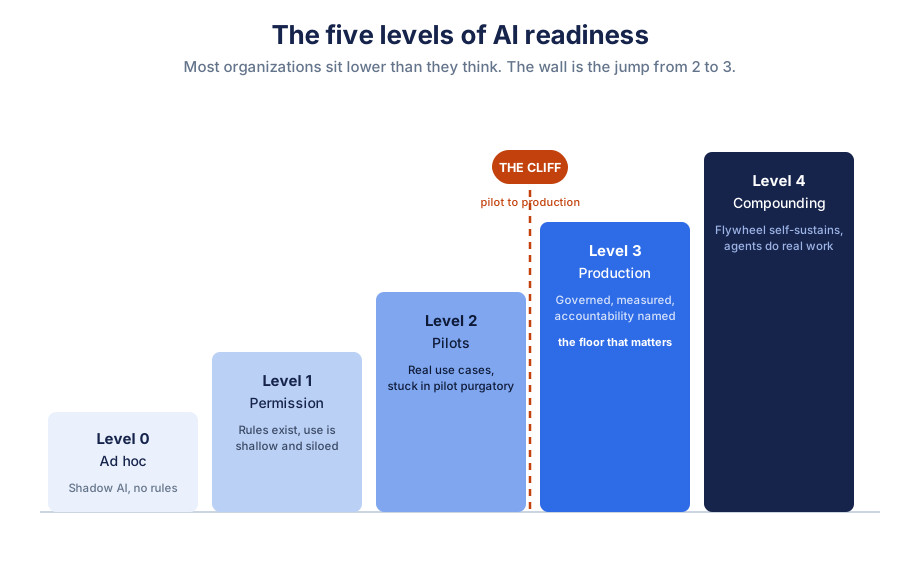
Enterprise AI readiness moves through five levels, from zero to four. You climb by spinning the flywheel. Most organizations sit lower than they think, because tools running somewhere is not the same as AI doing governed, scaled work. The honest question is not whether your people use AI. It is whether AI is doing reliable, independent work inside real processes.
| Level | What it looks like | What is true about adoption |
|---|---|---|
| 0 Ad hoc | Shadow AI everywhere, no rules, no visibility | People use AI, leadership cannot see or govern it |
| 1 Permission | Rules, a data baseline and sanctioned tools exist | Use is shallow, siloed, mostly individual productivity |
| 2 Pilots | Real use cases run, a few early wins | Stuck in pilot purgatory, the frozen middle blocks scale |
| 3 Production | Proven workflows live with governance and measurement | AI is part of operational delivery, accountability is named |
| 4 Compounding | The flywheel self-sustains across functions | AI is embedded in how work happens, agents do independent work |
The Level 2 to 3 cliff
The wall almost everyone hits is the jump from Level 2 to Level 3. Gartner names this pilot-to-production transition as the single most common failure point in enterprise AI. You get a pilot that dazzles in a demo and dies in production, because there was no shared operating framework underneath it.
Level 3 is the floor that matters, not Level 4. It is the minimum maturity where AI is governed, measured, and reliable enough to trust with real operations. Get there first. Level 4 is where the wheel spins on its own and you are promoting new use cases faster than competitors can copy the last ones. That is the gradually and then suddenly moment, where months of preparation turn into a step change nobody outside the building saw coming.
The takeaway
Place yourself honestly. Most organizations sit at Level 1 or 2. The whole game is surviving the jump to Level 3, where AI is governed, measured and real.
Score your AI readiness across six dimensions
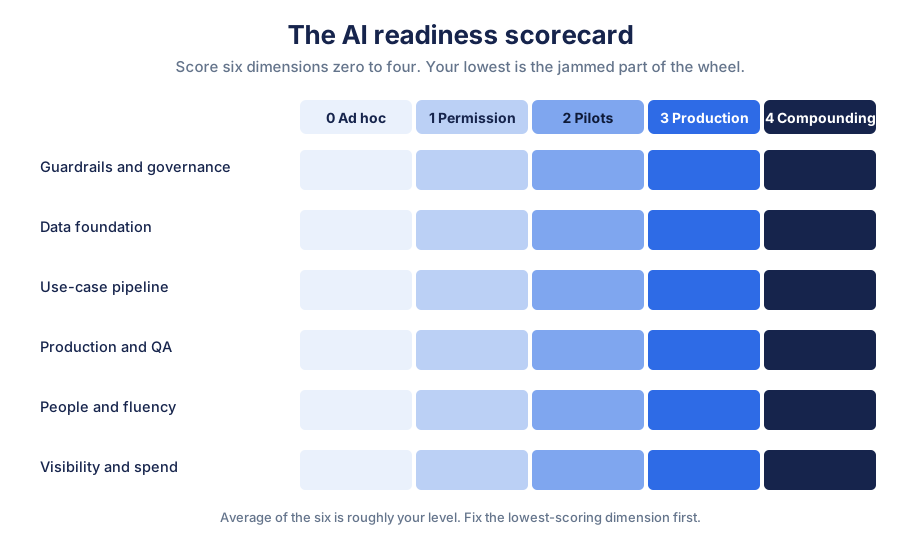
Score yourself across six dimensions, each from zero to four against the ladder above. Your average is roughly your level. Your lowest dimension is the jammed part of the flywheel, and that is where you start, not your strongest area and not the one that is loudest in meetings.
The six dimensions
| Dimension | The question it answers |
|---|---|
| Guardrails and governance | Do clear rules, decision rights and standards exist, or is it the wild west |
| Data foundation | Is your data AI ready, not just BI ready |
| Use-case pipeline | How do real use cases get surfaced, and who is allowed to propose them |
| Production and QA | Can you move a pilot to production and prove it works |
| People and fluency | Do people across functions have the literacy and the cover to use AI well |
| Visibility and spend | Can you see shadow AI, tool sprawl and the real cost of what you run |
Why your lowest score is the one that matters
A flywheel only spins as fast as its slackest point allows. You can have brilliant governance and a strong data foundation, but if your use-case pipeline is empty because nobody below the C-suite is allowed to experiment, the wheel does not turn. People and culture are still the most underfunded dimensions in enterprise AI, even in technically strong organizations, and culture, not technology, is the barrier leaders name most.
Interactive assessment
Where does your organization actually stand?
Score the six dimensions from zero to four. Your lowest score is where you start.
Your scores
Your jammed dimension
Your next 90 days
Prefer to run this in a workshop? The interactive scorecard above gives the same six-dimension read in a few minutes.
The takeaway
Your average is your level. Your lowest dimension is your starting line. Fix the slackest point first, because that is what is holding the wheel.
The next four sections walk the flywheel as a sequence you can run.
Plan, set the guardrails and the data foundation
Planning is where you build the rudder. Before any motor, you need decision rights, a governance structure people can name, and data organized well enough that AI produces right answers instead of fast wrong ones. Governance done right is a tailwind, not a speed bump, because it is what lets you say yes quickly and safely.
Fix the data rudder first
Start with the question Burns puts first. Are your core systems and data organized to accommodate AI? "AI ready" data is not the same as "BI ready" data. A table that powers a clean dashboard can be useless for an AI workflow because it lacks the structure or context the model needs. Poor data quality is cited by 43 to 46 percent of enterprises as the primary barrier to AI (via Janea Systems, 2026). Fix the rudder before you bolt on the motor.
Set guardrails your board already recognizes
You do not have to invent these from scratch. The frameworks already exist and your board will know them.
- The NIST AI Risk Management Framework and its GOVERN function, which places executive accountability for AI risk where it belongs, at the top.
- ISO 42001, whose Clause 5.1 requires top management to demonstrate leadership and commitment to the AI management system.
- The EU AI Act, with high-risk obligations enforceable from August 2026 and penalty tiers reaching up to 35 million euros or 7 percent of global turnover for prohibited practices.
Governance is no longer a compliance afterthought. Boards now hold technology leaders personally accountable for AI failures, which is why the conversation in 2026 has shifted from "how do we use AI for growth" to "how do we govern the intelligence that is already running." Your job here is to give that intelligence a structure, not to slow it down. For the data and platform groundwork itself, this is where a data management and technology consulting partner earns its keep.
The takeaway
Strong rudder before big motor. Get core data AI ready and align governance to a framework your board already knows.
Implement, get from pilot to production
Implementation is the Level 2 to 3 climb, and it is where most programs go to die. The blocker is rarely the model. It is the frozen middle, the layer of management, legacy process and habit that resists change. You beat it with named accountability and ruthless use-case selection, not with another pilot.
Pick use cases like an operator
Not the flashiest one, the one with the clearest line to a number you already report. Data informed, not data driven, as Oz puts it, because the judgment still matters, the data just sharpens it. Tie every initiative to a metric the business already cares about and you give the frozen middle nothing to argue with.
Put two names on every initiative
The most reliable pattern emerging across enterprise AI is joint accountability, a named technical sponsor and a named business sponsor who co-own the outcome. One owns whether it works. The other owns whether it matters. When both names are on the wall, the project stops being IT's hobby and starts being the business's commitment.
A quick reality check before you scale anything. Deploying a model to ten users is trivial. Deploying to ten thousand means concurrency, latency, monitoring and cost discipline, and this is exactly where roughly a quarter of organizations stall (via Janea Systems, 2026). Production is an engineering standard, not a demo that got popular. Treat it that way from the first pilot.
The takeaway
One pilot, two named sponsors, a metric you already report. That beats five new pilots every time.
QA, prove it works and keep it working
QA is the gate that separates a pilot that impressed people from a workflow you can trust. It means continuous measurement, drift monitoring, a real read on cost, and a documented answer to one question. Is this still doing the job, today, at this scale, within the rules? Without that gate, you are not in production. You are in a long demo.
Measure the full cost, not the pilot's promise
A use case can look like a win and quietly lose money once you count the cost of running tokens, handling traffic and serving retrieval at scale. Leaders are learning this the hard way, which is part of why only 19 percent say AI has met its business goals (CIO.com, 2026). What looks good on paper has to survive contact with operational cost.
Keep watching after it ships
Mature organizations build continuous monitoring to catch drift, bias and performance decay over time, with auditability so any AI-influenced decision can be traced and explained. That traceability is not bureaucracy. It is the trust metric your board needs to defend the program, and increasingly the evidence a regulator will ask for. This is also where most "Level 3" claims fall apart on inspection. Policies exist on paper while shadow AI and manual inventory still run underneath. Real QA closes that gap between what your governance says and what your org actually does.
The takeaway
If you are not measuring drift and the full cost to run it, you are not in production. You are in a long demo.
Foster adoption over time, spin the flywheel
Fostering adoption is the move that turns a few production wins into a compounding advantage. You take a proven use case from one function and make it the baseline for the next, you build fluency so people can run AI without a bottleneck, and you keep governance learning as fast as the technology. This is the flywheel at full speed, and it is the whole point.
Spread beats scale
One team solving a problem with a governed, measured workflow is worth far more once you template it and move it across functions, which is exactly the motion Oz used inside MSH, promoting what worked consistently rather than reinventing it function by function. Standardize the win, then hand it to the next team ready to run.
Most of the work is human
None of that spreads without people. Build AI literacy across every level, not just the data science team, because business leaders and operational staff are where adoption lives or dies. This is change leadership done with clarity and empathy, and it is why culture, not tooling, is the most cited barrier to AI success. The separation is in the preparation, and most of that preparation is human.
One more shift is coming fast, so plan for it now. As agents start doing independent work, governance has to operate at speed, adapting in near real time rather than reviewing after the fact. The organizations that reach Level 4 are the ones whose guardrails learn as quickly as their agents act. Around 79 percent of companies already report adopting AI agents in some form (PwC), so this is a 2026 problem, not a someday problem.
The takeaway
Spread beats scale. Template the win, move it to the next function, and teach the people who will run it.
Your first 90 days, by where you stand
Your first move depends on your level, not on a generic checklist. Find yourself below and start there. The goal for most organizations is not to become AI native overnight. It is to get to Level 3, where AI is governed, measured and real, because that is where the compounding starts.
| If you are at | Your first 90 days | The trap to avoid |
|---|---|---|
| Level 0 Ad hoc | Get visibility into shadow AI, set basic rules, sanction a tool set | Banning everything and pushing usage further underground |
| Level 1 Permission | Stand up a use-case pipeline, run two or three measured pilots | Pilots with no metric attached, so you cannot tell wins from noise |
| Level 2 Pilots | Pick one pilot, name both sponsors, harden it to production standard | Starting five new pilots instead of finishing one |
| Level 3 Production | Template a proven workflow and spread it to a second function | Hoarding the win in one team instead of standardizing it |
| Level 4 Compounding | Move governance to real time for agentic work, keep promoting use cases | Letting standardization calcify into "only safe, low-value use cases" |
A note for the leaders skipping ahead. Do not. Trying to jump from Level 1 to Level 3 by buying a big platform and hiring a large team usually buys you 12 to 18 months of infrastructure with no business value, followed by budget cuts. Each level builds the capability the next one needs. A well-run Level 2 takes months. A failed skip takes years.
Find your level, then build from it
Score yourself with the assessment above, then talk to a partner who can build the operations and place the people who run them.
Explore MSH technology consultingFrequently asked questions
What is enterprise AI readiness?
Enterprise AI readiness is an organization's capacity to govern AI use from the top while enabling experimentation from the bottom, so AI moves from scattered individual use into reliable, scaled production workflows. It is measured across governance, data, use-case pipeline, production capability, people and visibility, not by how many AI tools a company owns.
How do I assess my organization's AI readiness?
Score six dimensions from zero to four. Guardrails and governance, data foundation, use-case pipeline, production and QA, people and fluency, and visibility and spend. Your average maps to a readiness level from zero to four, and your lowest-scoring dimension is the bottleneck to fix first. The interactive scorecard above runs this in a few minutes.
Why do most enterprise AI pilots fail to scale?
Most stall at the jump from pilot to production, the move from Level 2 to Level 3, which Gartner identifies as the most common failure point. The cause is usually organizational, not technical. No shared operating framework, no named accountability, a data foundation that cannot support production, and a frozen middle of process and habit that resists change. Around 95 percent of AI initiatives stall before full production (MIT, State of AI in Business 2025).
What is the difference between AI readiness and AI maturity?
Readiness describes your current capacity to adopt and scale AI safely, the starting position you assess. Maturity describes how far AI is actually embedded in how the organization operates, the level you climb to over time. You assess readiness to find your level, then build maturity by spinning the adoption flywheel through plan, implement, QA and spread.
Who owns AI readiness, the CIO or the CAIO?
Whoever holds clear, named accountability for it, with cross-functional authority to set guardrails and remove friction. Many organizations now appoint a Chief AI Officer for this, but the title matters less than the mandate. The most effective setups pair executive ownership of governance with joint accountability at the project level, a named technical sponsor and a named business sponsor co-owning each outcome.
.jpeg)